Free UK Mainland Shipping on Orders Over £25 (ex VAT)


Ultrasound Machines
(4)
Ultrasound Machines
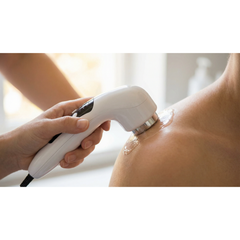
Ultrasound machines are used to deliver high-frequency sound waves into soft tissue as part of targeted therapeutic ultrasound. In rehabilitation, musculoskeletal therapy and general soft tissue treatment, an ultrasound machine is valued for its ability to focus treatment on a specific area rather than applying broad, surface-level heat. That makes therapeutic ultrasound particularly relevant where localised treatment, controlled application and portability are important.
Most therapeutic ultrasound machines operate at either 1 MHz or 3 MHz, and that difference in frequency is central to how the machine is used. Frequency affects treatment depth, which is why it is one of the first things to understand when comparing machines. Alongside frequency, other important factors include portability, ease of use, the shape and practicality of the sound head, and whether gel and supporting accessories are readily available.
What does an Therapeutic Ultrasound Machine do?
A therapeutic ultrasound machine converts electrical energy into mechanical sound waves. This happens through a transducer, often called the sound head or probe, which contains piezoelectric crystals. When electrical current passes through those crystals, they vibrate at a very high frequency and create ultrasound waves well above the normal range of human hearing. Those waves are then delivered into the treatment area through the skin using ultrasound gel as the coupling medium.
In practical terms, this means an ultrasound machine is designed for targeted application. The sound head is moved over the affected area so the treatment can be directed where it is needed rather than spread across a wider surface. That targeted method is one reason ultrasound machines are widely used in soft tissue therapy, rehabilitation and ongoing treatment settings.
How Therapeutic Ultrasound works
When ultrasound waves enter the tissue, they create microscopic vibrations. These vibrations are associated with the therapeutic effects that make an ultrasound machine useful in this category. One of the best-known effects is the generation of localised heat. As the tissue temperature rises, local circulation can be supported, along with the movement of oxygen and other essential substances through the area being treated. This is one reason therapeutic ultrasound is commonly discussed in connection with tissue recovery and rehabilitation.
Therapeutic ultrasound is not only described in terms of heat. Ultrasound machines are also associated with non-thermal or mechanical effects. Terms such as cavitation and acoustic streaming are often used to describe this process. In simple terms, the mechanical action created by the sound waves can contribute to the tissue-focused nature of the treatment. For product comparison purposes, the important point is that an ultrasound machine is not just a basic heat device. It offers a more controlled and targeted therapy method.
Different tissues absorb ultrasound energy at different rates, which is one reason treatment depth matters so much. It is also why the choice between a 1 MHz ultrasound machine and a 3 MHz ultrasound machine is such an important part of the buying decision.
1 MHz and 3 MHz Ultrasound Machines
The difference between 1 MHz and 3 MHz ultrasound machines is one of the most common questions for this type of machine. In straightforward terms, 1 MHz ultrasound machines are generally used where deeper penetration is required, while 3 MHz ultrasound machines are more often associated with treatment areas closer to the surface.
A 1 MHz ultrasound machine is usually considered for larger muscle groups, deeper ligaments, deeper tendons, joints and other structures that are not superficial. Because the energy is absorbed more gradually, 1 MHz is commonly linked with deeper tissue treatment and broader musculoskeletal applications. Anyone comparing options for deeper treatment areas can look more closely at a 1 MHz ultrasound machine.
By contrast, 3 MHz ultrasound machines are generally more relevant when the intended treatment area is nearer the surface. The shorter wavelength and more superficial absorption make them suitable for more superficial structures. A fuller comparison of treatment depth, use cases and frequency selection is covered in 1 MHz and 3 MHz ultrasound machines.
Why frequency matters in Ultrasound machines?
Frequency is not a minor technical detail. It shapes how an ultrasound machine fits the intended treatment area. A machine chosen for deeper muscular structures will not necessarily be the right option for a more superficial area, and the same applies in reverse. This is why a frequency-led comparison is often more useful than choosing on appearance alone.
In practical use, 1 MHz is commonly associated with deeper areas such as larger muscles, deeper soft tissue structures and broader musculoskeletal regions. 3 MHz is more commonly associated with superficial treatment zones. Understanding that distinction makes it easier to narrow down the most suitable ultrasound machine without overcomplicating the decision.
Thermal and Mechanical effect of Ultrasound Therapy
The thermal effect of an ultrasound machine is often the easiest part to understand. As sound waves move through tissue, they generate localised heat. That warming effect is associated with increased blood circulation and support for soft tissue treatment. In therapy settings, localised heat is often discussed in relation to tissue extensibility, recovery and rehabilitation.
The mechanical side of therapeutic ultrasound is equally important. Even where heat is not the only focus, the movement created by ultrasound waves can still influence the treatment area at a microscopic level. This helps explain why ultrasound machines are regularly described as more than a simple warming device. Their value lies in controlled sound-wave treatment rather than general heat alone.
Deep & Superficial Treatment
An ultrasound machine is often selected according to whether the intended treatment area is deep or superficial. For deeper tissue work, 1 MHz is usually the starting point. That is why deeper muscular structures, lower back regions and broader soft tissue areas are frequently linked with 1 MHz ultrasound machines. For more superficial areas, 3 MHz is often more appropriate.
This distinction also helps answer one of the most common search-led questions in the category: whether a machine is suitable for specific body areas. A machine chosen for deeper structures should be selected with penetration depth in mind, not simply output claims or appearance.
Why Ultrasound Gel matters?
Ultrasound gel is an essential part of using an ultrasound machine properly. The sound head needs a coupling medium so the ultrasound waves can pass effectively from the applicator into the treatment area.
Without gel, transmission is reduced and the device is not being used as intended. Gel also helps the sound head move more smoothly across the skin during treatment.
Benefits of therapeutic ultrasound machines
The appeal of a therapeutic ultrasound machine usually comes down to precision, portability and targeted treatment. The device is used directly on the area being treated, the treatment depth can be matched through the correct frequency, and the machine itself is compact enough for routine use in home or professional settings. That combination is one reason therapeutic ultrasound machines continue to attract consistent interest across therapy and rehabilitation categories.
Therapeutic ultrasound is also commonly associated with localised heat, circulation support, tissue-focused treatment and soft tissue rehabilitation. A broader overview of these points is available in benefits of a therapeutic ultrasound machine, which expands on the main therapeutic themes connected to this type of device.
For anyone researching further before choosing a machine, the most relevant supporting articles are 1 MHz and 3 MHz ultrasound machines, ultrasound machine for back pain and benefits of a therapeutic ultrasound machine. Together, these cover the main frequency, use-case and treatment questions most closely connected to ultrasound machine and ultrasound machines searches.